


These tiny controller boards are build to provide a quick start for projects with 8 and 20 pin AVR microcontrollers, e.g. ATtiny13, ATtiny45, ATtiny85 and ATtiny2313. They don’t include any fancy stuff, they are just as simple as possible.
Where is the problem?

Whenever I was prototyping on a breadboard I was annoyed by all the wires to setup before the actual project could begin. Arduino projects were much easier. The 6 pin ISP (In System Programming) header alone was troublesome. Make an adaptor to plug a 3×2 pin header on a breadboard. Then cut short wires and connect the controller to the header. Which pins are what? MOSI, MISO and SCK? So I decided to do it only once more.
The solution

These little breadboard headers are very handy. They occupy only one more row on each side as a controller would need. They include already:
- 6 pin ISP (In System Programming) header
- 8 MHz resonator
- Reset pull-up resistor and reset switch
- blocking capacitors
- Serial connection header (FTDI-cable compatible), only on the ATtiny2313-Header
If these boards look somehow familliar to you, they are inspired by the Arduino compatible RBBB and the Boarduino. If you put them side by side, the tiny boards look like younger brothers and sisters.
Failure
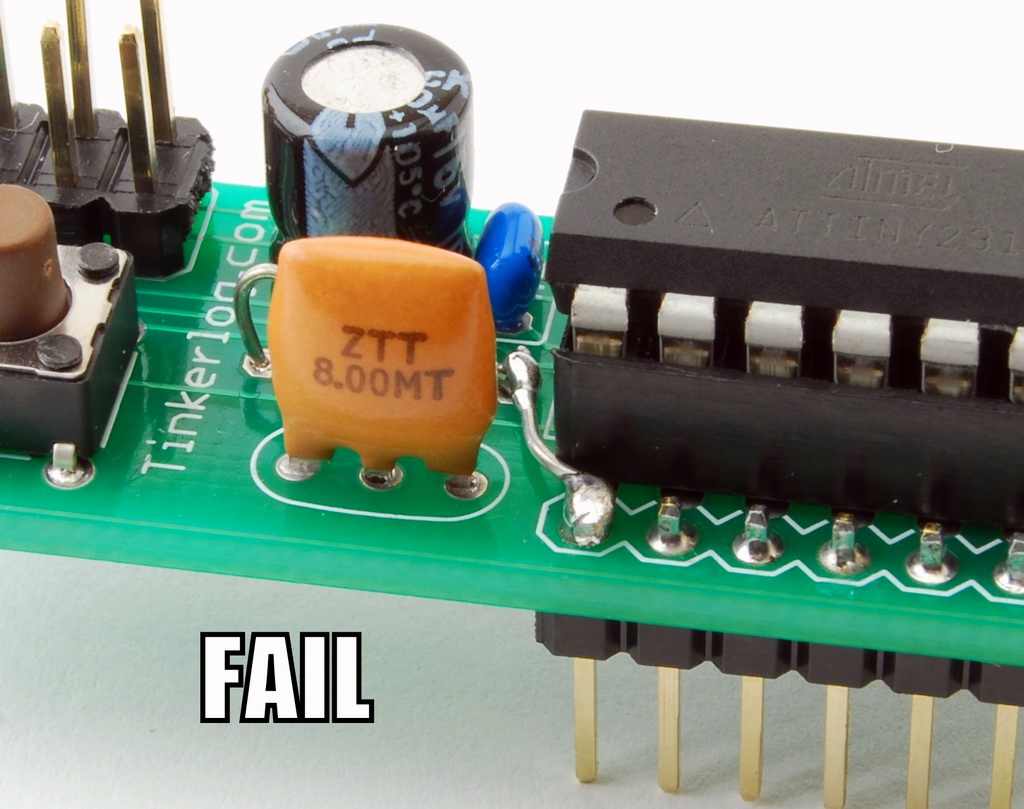
And as Sparkfun showed us that you don’t have to be ashamed of what you screw up, here is one of my failures. Because the routed connections between the controller and the pin headers looked a bit warped in Eagle CAD, I ripped them up and routed them by hand. And forgot to reroute the connection on pin 1! So always hit “ratsnest” at the end to check, if you missed something. Luckily it was easy to fix. Lesson learned. That’s why you are prototyping.
Outlook
They work like a charm. Just plug them in your breadboard and connect your programmer. Great. And don’t they look cute?
So now I am ready for a bigger batch of PCBs. Expect the header boards in the store maybe next month.
Downloads
- Eagle schematics: headers-v10
 tinkerlog
Those look great! My breakout adaptor for programming took a surprising amount of time to make and it’s ugly. These look like a perfect solution!
LikeLike
Very nice!
They came out much nicer than I thought!
Have you tried adding an socket for the resonator? So you can use the boards at different speeds? Or is it too unstable?
LikeLike
No, I haven’t. I think I will just make another, if I need a different speed or different controller. Remember, just plug and go. ;)
LikeLike
Looking forward to pick up some of these – Actually a single sided board might be nice to try and make at home.
LikeLike
That looks good, how much are you expecting these to cost when they go on sale.
LikeLike
Hi Nick,
I expect them be around $8-12.
Cheers,
Alex
LikeLike
Do I get it right that you are forwarding all Atmel pins directly to the header on the bottom side of the board? I don’t think this makes sense for the oscillator connections. And I’d really like to see a 12MHz crystal so you can easily an USB slave device implementation on the 2313.
@George G: I don’t really think these like to be done single-sided. The pin headers on the bottom side should be soldered from the top to increase mechanical stability. You could get one done single-sided though by using SMD components.
LikeLike
Hi Hans,
yes, all pins are directly connected to the headers. And maybe I will have an option to select different resonators.
Cheers,
Alex
LikeLike
I’ve been looking for something like this for a long time. When do you think they will be available for sale?
LikeLike
Cool project. I’d like to see support for a crystal though. Do you think you could set the board up so it could be populated with either crystal or resonator? I don’t care much for sockets on those parts, but it would be nice to be able to use the same board for both configurations.
LikeLike
Would you mind posting a schematic so I can breadboard this?
LikeLike
Hi Daemach,
I added a zip with Eagle-CAD schematics. Board layouts will be released when I am finished with the boards.
Cheers,
Alex
LikeLike
I’m really looking forward to your PCB’s arriving and making an order for them! Thanks!
LikeLike
Thanks much. Please consider creating full kits with all components included. Better make a bunch though…
LikeLike
A jack for a 9v DC wall-wart and a VR would be another outstanding addition…
LikeLike
I am a complete noob but I was looking for a way to use my Arduino Diecimila to program an 8-pin ATtiny chip. Is that what this header allows me to do? What do I exactly need to program an 8-pin ATtiny. Do I use the same Arduino software? do I need another cable to connect to your header? Or do I still use my Diecimila AND your header?
LikeLike
Hi Mike,
no, you will need an ISP programmer to program these header boards (e.g. usbtinyisp). But you can turn your Arduino into an ISP programmer. Take a look at http://www.uchobby.com/index.php/2007/11/04/arduino-avr-in-system-programmer-isp/
And you write your software in assembler or C.
Cheers,
Alex
LikeLike
Wow, so nice. I’m not that good in building circuits. Can you explain me what those capacitors are doing. Flattening the power source input?
Thanks, ruedi.
LikeLike
Hi ruedi,
yes, that’s exactly what they are for.
Cheers,
Alex
LikeLike
Hi Alex,
Nice boards! Just wondering: could you please add the Eagle board file for the ATtiny45/85 version to the zip?
Thanks, Lennart
LikeLike
Hi Lennart,
check out the howto page. There is a zip with schematic and board layout.
https://tinkerlog.com/howto/tiny25-header/
Cheers,
Alex
LikeLike